Author Archives: Byung-Jun Yoon

Unknown's avatar

About Byung-Jun Yoon

I am a Professor at Texas A&M University, Department of Electrical & Computer Engineering, and a Scientist at Brookhaven National Laboratory, Computational Science Initiative. My research interests include objective-based uncertainty quantification, optimal experimental design (OED), machine learning, and signal processing. Application areas of interest include bioinformatics, computational network biology, and AI-driven drug/materials discovery.

ACM-BCB 2024 will take place in Shenzhen, China, Nov. 22-25, 2024

The 15th ACM Conference on Bioinformatics, Computational Biology, and Health Informatics (ACM-BCB 2024) is the flagship conference of the ACM SIGBio. It will be held for the first time outside of USA in Shenzhen China during Nov 22-25, 2024, after past successes in many USA locations. ACM-BCB 2024 aims to promote AI for Bio-medicine (AI4Bio), including cutting-edge AI advances in computational biology, bioinformatics, and health informatics, at the intersection of computer science, artificial intelligence, statistics, biology, and medicine.

For further information, please visit: https://hpcc.siat.ac.cn/acm-bcb2024

[Download ACM-BCB 2024 call for paper]

[Postdoc opening] Apply for a postdoc position in Scientific Computing, Machine Learning, Applied Mathematics

We are happy to announce a new postdoc position in the area of Scientific Computing, AI/ML, and applied mathematics.

The Applied Mathematics Group of the Computational Science Initiative (CSI) at Brookhaven National Laboratory (BNL) invites exceptional candidates to apply for a postdoctoral research associate position in applied mathematics, scientific computing, and machine learning. This position offers a unique opportunity to conduct research in emerging interdisciplinary research problems at the intersection of applied mathematics, machine learning, and high-performance computing (HPC) with applications in diverse scientific domains of interest to BNL and the Department of Energy (DOE). Topics of specific interest include: (i) decision making under uncertainty / optimal design and control of experiments and physical or biological systems; (ii) uncertainty quantification for physical or biological systems or machine learning; (iii) optimization; (iv) model reduction / digital twins / surrogate modeling or emulation; (v) modeling & simulation; (vi) scientific machine learning; (vii) computational and experimental workflows and pipelines for science and engineering problems. The position includes access to world-class HPC resources, such as the BNL Institutional Cluster and DOE leadership computing facilities. Access to these platforms will allow computing at scale and will ensure that the successful candidate will have the necessary resources to solve challenging DOE problems of interest.

This program provides full support for two years at CSI with a possible extension. Candidates must have received a doctorate (Ph.D.) in applied mathematics, statistics, computer science, or a related field (e.g., mathematics, engineering, operations research, physics) within five years of the negotiated start date of the position. This postdoc position presents a unique chance to conduct interdisciplinary collaborative research in BNL programs with a highly competitive salary.

For further details, please visit the URL below:

https://bnl.wd1.myworkdayjobs.com/Externa/job/Upton-NY/Postdoc—Applied-Mathematics—Scientific-Computing_JR101026

The postdoc will be primarily mentored by and work with Dr. Byung-Jun Yoon and will also actively collaborate with other members of the Applied Mathematics Group at BNL.

[Open Position] BNL’s Amalie Emmy Noether Postdoctoral Fellow in Applied Mathematics and Scientific Computing now accepting applications

The Applied Mathematics Group of the Computational Science Initiative (CSI) at Brookhaven National Laboratory (BNL) invites exceptional candidates to apply for the Amalie Emmy Noether Postdoctoral Fellowship in applied mathematics and scientific computing.

This fellowship offers a unique opportunity to conduct research in a broad set of fields, including decision-making under uncertainty, scientific machine learning, reduced order or surrogate modeling, uncertainty quantification and scalable computational statistics, model-form errors, optimization, optimal experimental design, high-dimensional inverse problems, data science for streaming parallel/distributed analytics for high-performance computing (HPC), integrated or compositional computational modeling frameworks, numerical methods, and multiscale modeling and simulation.

For further details, please visit: [Apply for Noether Postdoc Fellow Position]

Advancing Materials Science through uncertainty-aware, physics-informed, and knowledge-driven AI/ML models

Significant acceleration of the future discovery of novel functional materials requires a fundamental shift from the current materials discovery practice, which is heavily dependent on trial-and-error campaigns and high-throughput screening, to one that builds on knowledge-driven advanced informatics techniques enabled by the latest advances in signal processing and machine learning.

In a recent review article published in Patterns, an open-access journal from Cell Press focused on data science, we discuss the major research issues that need to be addressed to expedite this transformation along with the salient challenges involved. We especially focus on Bayesian signal processing and machine learning schemes that are uncertainty-aware and physics-informed for knowledge-driven learning, robust optimization, and efficient objective-driven experimental design.

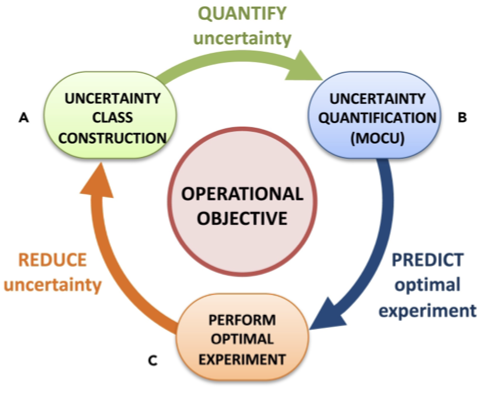
Illustration of the optimal experimental design (OED) cycle that is enabled by knowledge-driven and objective-based uncertainty quantification via MOCU (mean objective cost of uncertainty)

For further details, please refer to the paper below:

Xiaoning Qian, Byung-Jun Yoon, Raymundo Arróyave, Xiaofeng Qian,
Edward R. Dougherty, “Knowledge-Driven Learning, Optimization, and Experimental Design under Uncertainty for Materials Discovery“, Patterns, volume 4, issue 11, 100863, Nov. 10, 2023. https://doi.org/10.1016/j.patter.2023.100863

Accelerating scientific advances and discoveries through artificial intelligence (AI) and machine learning (ML)

A recent editorial by Dr. Byung-Jun Yoon and co-authors Francis J. Alexander, Meifeng Lin, and Xiaoning Qian published in Patterns from Cell Press discusses how AI/ML, data-driven modeling, and scientific computing can significantly accelerate scientific advances and novel discoveries.

Francis J. Alexander, Meifeng Lin, Xiaoning Qian, and Byung-Jun Yoon, “Accelerating scientific discoveries through data-driven innovations,” Patterns, volume 4, issue 11, 100876, Nov. 10, 2023. https://doi.org/10.1016/j.patter.2023.100876

Developing artificial intelligence (AI) and machine learning (ML) methods that can accelerate scientific discoveries and advance science has become one of the important research directions for the AI/ML research community. It has been gaining increasing attention from researchers in diverse scientific areas, including biomedical science, materials science, climate science, physics, chemistry, and many others. Data-driven AI/ML innovations to enable reliable predictions and optimal decision-making for scientific discoveries face several critical challenges, among which are high system complexity, large search space, incomplete knowledge, and small data, all of which demand novel strategies to effectively address them. Meeting these challenges and thereby accelerating scientific discoveries and industrial innovations, calls for research that can take full advantage of the latest advances in AI/ML to integrate data-driven techniques with scientific knowledge and is able to execute them in modern high-performance computing (HPC) environments at scale.

Those who are interested in learning more about the recent advances in relevant fields are referred to the Patterns Special CollectionAccelerating scientific discoveries through data-driven innovations”, which features articles that showcase the promising roles of AI/ML and data-driven modeling in accelerating scientific discoveries and may inspire the next wave of data-driven innovations in various scientific domains.

Optimizing high-throughput virtual screening campaigns

The need for efficient computational screening of molecular candidates that possess desired properties frequently arises in various scientific and engineering problems, including drug discovery and materials design. However, the enormous search space containing the candidates and the substantial computational cost of high-fidelity property prediction models make screening practically challenging.

In our recent work published in Patterns, a premium open-access journal from Cell Press, we propose a general framework for constructing and optimizing a high-throughput virtual screening (HTVS) pipeline that consists of multi-fidelity models. The central idea is to optimally allocate the computational resources to models with varying costs and accuracy to optimize the return on computational investment. Based on both simulated and real-world data, we demonstrate that the proposed optimal HTVS framework can significantly accelerate virtual screening without any degradation in terms of accuracy. Furthermore, it enables an adaptive operational strategy for HTVS, where one can trade accuracy for efficiency.

Optimal decision-making in high-throughput virtual screening pipelines

For further details, please refer to the paper at the link below:
https://www.cell.com/patterns/fulltext/S2666-3899(23)00267-2

Uncertainty-aware framework for quantifying the reproducibility of scientific workflows that involve AI/ML models

The capability to replicate the predictions by machine learning (ML) or artificial intelligence (AI) models and the results in scientific workflows that incorporate such ML/AI predictions is driven by a variety of factors. An uncertainty-aware metric that can quantitatively assess the reproducibility of the quantities of interest (QoI) would contribute to the trustworthiness of the results obtained from scientific workflows involving ML/AI models.

In a recent perspective article published in Digital Discovery – from the Royal Society of Chemistry (RSC) – we discuss how uncertainty quantification (UQ) in a Bayesian paradigm can provide a general and rigorous framework for quantifying the reproducibility of complex scientific workflows. Such frameworks have the potential to fill a critical gap that currently exists in ML/AI for scientific workflows, as they will enable researchers to determine the impact of ML/AI model prediction variability on the predictive outcomes of ML/AI-powered workflows. We expect that the envisioned framework will contribute to the design of more reproducible and trustworthy workflows for diverse scientific applications, and ultimately, accelerate scientific discoveries in the future.

For more information, access the full article at the link below:

https://pubs.rsc.org/en/content/articlelanding/2023/DD/D3DD00094J

Epidemiological Modeling in the Exascale Era and Decision-Making Under Uncertainty

Dr. Yoon will be serving as a PI of a new DOE-funded $12M project entitled “EMERGE: ExaEpi for Elucidating Multiscale Ecosystem Complexities for Robust, Generalized Epidemiology” (Lead-PI: Dr. Peter Nugent, Lawrence Berkeley National Laboratory). This project is part of DOE’s Biopreparedness Research Virtual Environment (BRaVE) initiative, which supports national biopreparedness and response capabilities that can be advanced with DOE’s distinctive capabilities.

Epidemiological models are indispensable tools for predicting, understanding, and mitigating the impact of infectious diseases. In the early days of the COVID-19 pandemic, Berkeley Lab researchers led a multi-institutional effort to develop an agent-based model that could effectively harness the power of cutting-edge exascale supercomputers to speed predictions of disease spread for the Centers for Disease Control and Prevention and other public health agencies.

The EMERGE (ExaEpi for Elucidating Multiscale Ecosystem Complexities for Robust, Generalized Epidemiology) team will build on their successes and expand the capabilities of ExaEpi, an exascale-ready epidemiological agent-based model to target six diseases: COVID-19, influenza, cholera, Zika, Nipah virus, and Burkholderia pseudomallei. Ultimately, the goal is to make ExaEpi a generalized tool for epidemiology and ensure that it will be flexible enough to rapidly incorporate new diseases, including those that impact plants and other animals.

The project will be led by Dr. Peter Nugent, a senior scientist in Berkeley Lab’s Applied Mathematics and Computational Research (AMCR) division, serving as the lead-PI of EMERGE. Working with Dr. Nugent, Dr. Yoon will serve as one of the PIs of this multi-institutional collaborative project, mainly focusing on aspects that involve decision-making based on epidemiological models under uncertainty.

For further details, please see the announcement at: https://newscenter.lbl.gov/2023/09/13/berkeley-lab-national-biopreparedness-and-response-efforts/

Dr. Yoon’s research on continuous super-resolution AI model for climate data featured on SIAM NEWS

Dr. Xihaier Luo (Assistant Computational Scientist, Brookhaven National Laboratory) and Dr. Yoon’s joint work on deep network models for continuous super-resolution for climate data has been featured on the front page of SIAM NEWS on July 17, 2023.

This research proposes an innovative coordinate-based deep learning model to address the challenge of continuous super-resolution for climate data. Specifically, the team has focused on developing an implicit neural network model that is designed to learn continuous representations of climate data.

Further details can be found at the following link:

https://sinews.siam.org/Details-Page/advancing-wind-energy-forecasts-with-continuous-generative-representations

Scientific Reports Collection on Mathematical Oncology is now open for submissions

We are excited to announce that the Collection on Mathematical Oncology in Scientific Reports is now accepting submissions (submission deadline: December 2, 2023)

Mathematical oncology aims to contribute to a better understanding of cancer initiation, progression, and treatment, through the integration and application of mathematical models and simulations. Modelling cancer has become more feasible in recent decades, due to a combination of theoretical and technical advances, ever-expanding computational power, and a growing wealth of both experimental and clinical data. Mathematical models can be used to simulate tumour growth both forwards and backwards in time, and in response to treatments, improve our knowledge of individual cell behaviour, identify key features from complex data sets and clinical imaging, and ultimately develop patient-specific therapies and personalized medicine.

This Collection offers a platform for original contributions on mathematical oncology, from methodological advancements to applied clinical research, including integrative and multidisciplinary studies.

Guest Editors of this Collection will be:

  • Marek Kimmel: Professor of Statistics at Rice University
  • Francisco Rodrigues Pinto: Assistant Professor of Biochemistry, University of Lisbon
  • Byung-Jun Yoon: Associate Professor of Electrical & Computer Engineering at Texas A&M University

Fur further information about the Collection, please visit: https://www.nature.com/collections/eefhgjfege/